Leah Guren on demographic differences in using Help content
03/27/10 08:04 Filed in: search
Another great session from WritersUA. Leah Guren has
been conducting usability tests on populations using
software help systems to perform simple tasks. In
this study, she found that language, experience, and
age affect task performance.
Some of her conclusions:
Gender made no difference - women look for Help content, or ignore Help content, as much as men.
Experience can make a big difference. It takes 8 good successful sessions with help to make up for one bad experience where it didn't help. -- think indexes?
Age is a huge factor, and native tongue as well. These are both modified by experience, i.e., an older user who was very experienced with using other help systems were just fine, but older newbie users were not. Those working in a second language who again had more experience were just fine, but it was a barrier if the user was a newbie.
58% of users distrust Help - due to bad experiences.
Small onscreen text that appears in a bar above or below the window is not seen at all.
Side panels also disappear.
When readers look at a table of contents online that contains a ton of hierarchical structures, they don't use it. When asked why, they said that none of the headings seemed to help. Leah said that to a user, their question is first level important. We can assume that they want it up at the main heading level in a toc, or it is useless to them. So again, think indexes, we are the great levelers for people who think their search is important enough to be available on a first level basis.
I wish she had tested indexes, but oh well.
Links inside a paragraph lose users completely.
Vocabulary was a huge issue - again, there we can help teach users the domain language.
Some of her conclusions:
Gender made no difference - women look for Help content, or ignore Help content, as much as men.
Experience can make a big difference. It takes 8 good successful sessions with help to make up for one bad experience where it didn't help. -- think indexes?
Age is a huge factor, and native tongue as well. These are both modified by experience, i.e., an older user who was very experienced with using other help systems were just fine, but older newbie users were not. Those working in a second language who again had more experience were just fine, but it was a barrier if the user was a newbie.
58% of users distrust Help - due to bad experiences.
Small onscreen text that appears in a bar above or below the window is not seen at all.
Side panels also disappear.
When readers look at a table of contents online that contains a ton of hierarchical structures, they don't use it. When asked why, they said that none of the headings seemed to help. Leah said that to a user, their question is first level important. We can assume that they want it up at the main heading level in a toc, or it is useless to them. So again, think indexes, we are the great levelers for people who think their search is important enough to be available on a first level basis.
I wish she had tested indexes, but oh well.
Links inside a paragraph lose users completely.
Vocabulary was a huge issue - again, there we can help teach users the domain language.
Bob Boiko on the metatorial process
03/26/10 08:02 Filed in: tagging
Another great speaker at the WritersUA conference was
Bob Boiko. If you have not read his great Content
Management Bible, google it and read it online. Yes,
all 800 some pages. He loves indexing and tagging
data, so knowing him and quoting him when you are
talking to clients can establish a common vocabulary.
His talk this year was about the importance of the metatorial process. It is like the editorial process, but for your content's metadata. His strategy when approaching large bodies of data that need a schema is to ask these questions:
What underlying structures can be behind the surface structures we need?
How will we tag items so that they are part of the structures?
How much time and resource do we expect to get the backlog tagged and to tag on an ongoing basis?
How will we review, evaluate, and renew our approach?
He says that professionally tagging content is more important than social network tagging, because the content has to participate in another structure outside of the social one, and you must have consistency at the base of the information.
"Information strategy tells you what you had better be doing. Information structure tells you how you had better be doing it."
He feels that content writers and structurers (and us, as part of that) need to take control back from the IT people and drive the metatorial process.
Boiko is always worth reading and hearing if he comes near your town.
He has a course up at winhost.ischool.washington.edu/courseBook - go take a look!
His talk this year was about the importance of the metatorial process. It is like the editorial process, but for your content's metadata. His strategy when approaching large bodies of data that need a schema is to ask these questions:
What underlying structures can be behind the surface structures we need?
How will we tag items so that they are part of the structures?
How much time and resource do we expect to get the backlog tagged and to tag on an ongoing basis?
How will we review, evaluate, and renew our approach?
He says that professionally tagging content is more important than social network tagging, because the content has to participate in another structure outside of the social one, and you must have consistency at the base of the information.
"Information strategy tells you what you had better be doing. Information structure tells you how you had better be doing it."
He feels that content writers and structurers (and us, as part of that) need to take control back from the IT people and drive the metatorial process.
Boiko is always worth reading and hearing if he comes near your town.
He has a course up at winhost.ischool.washington.edu/courseBook - go take a look!
ebooks
03/25/10 07:57 Filed in: ebooks
WritersUa hosted Joshua Tallent of
ebookarchitects.com and kindleformatting.com for two
incredible sessions. I hope to upload the slide sets
when I get back to my office. Joshua covered the
formats, best features and failures of the currect
devices available in his first session, and also some
great distribution sources that can get your ebook
directly onto the channels at amazon, barnes and
noble, and other big sellers. In his second session,
he covers exactly how to create an ebook. We looked
at all the pieces and parts of a kindle-ready book
(mobi) and other readers that take the epub format.
What I learned was astonishing. If you are working
with a publisher who is using InDesign to prepare
their books for both print and ebook, they have to
change their layout practices. The placement of
pictures has to be done in a very specific way, and
it is not the way publishers usually do it! And,
small things like bolding text have to be done as
well in a very specific way. So one question you
should be asking any publisher who is coming to you
with an epub project is to ask them if they have
output epub before, because if they haven't, there
are some big surprises in store for them. All of this
is aside from the index question.
I have already seen Joshua's great implementation of live indexes in ebooks, and I got to see XML Press's implementation as well. Extremely interesting. Joshua's is very clean and user friendly. XML Press has chosen a method that is too cluttered, using the titles of the sections instead of small indicators, and they aren't going to the paragraph level either.
The sessions were well attended, which means that it's not just traditional publishers who are trying to do the ebook process, it is also documentation teams. So the more we know about the entire process, the better we can discuss with a multiple set of clients the issues and the challenges.
As an aside, my presentation on revamping the AutoCAD index was surprisingly swamped! I was out of handouts within minutes, and I wound up talking for about two hours. Much interest! Here I thought the documentation world was really into search at this point, but no, they seem to have discovered that indexes are still needed, and the approach I was taking with the AutoCAD indexing was of much interest. Hurrah!
I have already seen Joshua's great implementation of live indexes in ebooks, and I got to see XML Press's implementation as well. Extremely interesting. Joshua's is very clean and user friendly. XML Press has chosen a method that is too cluttered, using the titles of the sections instead of small indicators, and they aren't going to the paragraph level either.
The sessions were well attended, which means that it's not just traditional publishers who are trying to do the ebook process, it is also documentation teams. So the more we know about the entire process, the better we can discuss with a multiple set of clients the issues and the challenges.
As an aside, my presentation on revamping the AutoCAD index was surprisingly swamped! I was out of handouts within minutes, and I wound up talking for about two hours. Much interest! Here I thought the documentation world was really into search at this point, but no, they seem to have discovered that indexes are still needed, and the approach I was taking with the AutoCAD indexing was of much interest. Hurrah!
Metadata
03/22/10 07:56 Filed in: tagging
Great session on metadata today at WritersUA, with
good explanations of the Singapore framework, which I
was not up on. Mike Crandall of the University of
Washington went over modeling and interactivity
levels, and there are some new visual tools for
developing schemas. Check out
this
movie on some prototyping tools.
Go play with this music maker
03/22/10 07:54 Filed in: miscellany

Each dot you add makes a new tonal pattern, and the tool repeats it. Very fun to play with! There is also a guitar simulator. Play here!
Don't count sheep, do your ABC's
03/21/10 07:52 Filed in: miscellany
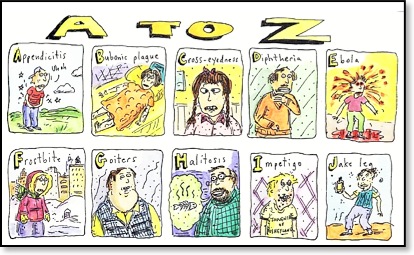
When Roz Chast can't sleep, she doesn't count sheep. She picks a subject and tries to find the ABC's for it. She takes on bodily woes in this cartoon. Extra points if you can define Jake Leg off the top of your head without using any search tools!
Digital decay
03/20/10 07:50 Filed in: books | publishing
The
New York Times
has an intriguing piece on how hard it is to archive
digital materials: Electronically
produced drafts, correspondence and editorial
comments, sweated over by contemporary poets,
novelists and nonfiction authors, are ultimately just
a series of digits — 0’s and 1’s — written on floppy
disks, CDs and hard drives, all of which degrade much
faster than old-fashioned acid-free paper. Even if
those storage media do survive, the relentless march
of technology can mean that the older equipment and
software that can make sense of all those 0’s and 1’s
simply don’t exist anymore.
Yet another entry in the ebook reader - Ibis
03/18/10 07:49 Filed in: ebooks
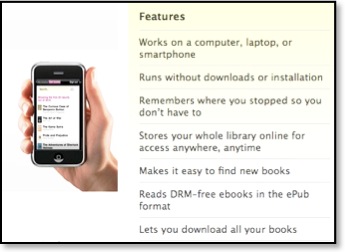
More info at ibisreader.com This reader allows you to read wherever and syncs up your location when you change devices.
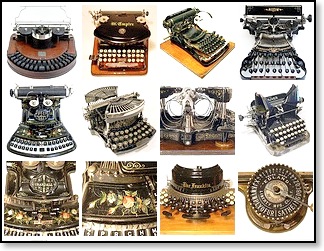
Cool! A whole site of antique typewriters
03/17/10 07:47 Filed in: miscellany

Felix gets to be in the index
03/14/10 17:01 Filed in: indexing
From
Peg Boyle Single's
story of her thesis and later book writing career, a
tribute to her dog Felix:
He had taken to snoring recently and the sound kept me company through final readings of my book, checking style sheets, and triple-checking Chicago Style formatting. I even took on the torturous task of self-indexing so that I could make sure that references to my four-legged writing partner made it into my book, something most
professional indexers would have rightly skipped.
He had taken to snoring recently and the sound kept me company through final readings of my book, checking style sheets, and triple-checking Chicago Style formatting. I even took on the torturous task of self-indexing so that I could make sure that references to my four-legged writing partner made it into my book, something most
professional indexers would have rightly skipped.
Story on cut paper art
03/13/10 17:00 Filed in: miscellany
You have to get through a toyota commercial first,
but wait through it because the
artwork is quite
spectacular.

Where are my scissors?
Where are my scissors?
Best file folder names yet
03/12/10 16:58 Filed in: miscellany
Clay Shirky's "Ontology is overrated" - good read
03/11/10 16:56 Filed in: taxonomies
Here's a
taste, and you can find the whole thing
here:
One reason Google was adopted so quickly when it came along is that Google understood there is no shelf, and that there is no file system. Google can decide what goes with what after hearing from the user, rather than trying to predict in advance what it is you need to know.
Let's say I need every Web page with the word "obstreperous" and "Minnesota" in it. You can't ask a cataloguer in advance to say "Well, that's going to be a useful category, we should encode that in advance." Instead, what the cataloguer is going to say is, "Obstreperous plus Minnesota! Forget it, we're not going to optimize for one-offs like that." Google, on the other hand, says, "Who cares? We're not going to tell the user what to do, because the link structure is more complex than we can read, except in response to a user query."
Browse versus search is a radical increase in the trust we put in link infrastructure, and in the degree of power derived from that link structure. Browse says the people making the ontology, the people doing the categorization, have the responsibility to organize the world in advance. Given this requirement, the views of the catalogers necessarily override the user's needs and the user's view of the world. If you want something that hasn't been categorized in the way you think about it, you're out of luck.
The search paradigm says the reverse. It says nobody gets to tell you in advance what it is you need. Search says that, at the moment that you are looking for it, we will do our best to service it based on this link structure, because we believe we can build a world where we don't need the hierarchy to coexist with the link structure.
One reason Google was adopted so quickly when it came along is that Google understood there is no shelf, and that there is no file system. Google can decide what goes with what after hearing from the user, rather than trying to predict in advance what it is you need to know.
Let's say I need every Web page with the word "obstreperous" and "Minnesota" in it. You can't ask a cataloguer in advance to say "Well, that's going to be a useful category, we should encode that in advance." Instead, what the cataloguer is going to say is, "Obstreperous plus Minnesota! Forget it, we're not going to optimize for one-offs like that." Google, on the other hand, says, "Who cares? We're not going to tell the user what to do, because the link structure is more complex than we can read, except in response to a user query."
Browse versus search is a radical increase in the trust we put in link infrastructure, and in the degree of power derived from that link structure. Browse says the people making the ontology, the people doing the categorization, have the responsibility to organize the world in advance. Given this requirement, the views of the catalogers necessarily override the user's needs and the user's view of the world. If you want something that hasn't been categorized in the way you think about it, you're out of luck.
The search paradigm says the reverse. It says nobody gets to tell you in advance what it is you need. Search says that, at the moment that you are looking for it, we will do our best to service it based on this link structure, because we believe we can build a world where we don't need the hierarchy to coexist with the link structure.
Must read article about Google
03/08/10 16:54 Filed in: search
From Wired magazine:
Want to know how Google is about to change your life?
Stop by the Ouagadougou conference room on a Thursday
morning. It is here, at the Mountain View,
California,
headquarters
of the world’s most powerful Internet company, that a
room filled with three dozen engineers, product
managers, and executives figure out how to make their
search engine even smarter. This year, Google will
introduce 550 or so improvements to its fabled
algorithm, and each will be determined at a gathering
just like this one. The decisions made at the weekly
Search Quality Launch Meeting will wind up affecting
the results you get when you use Google’s search
engine to look for anything — “Samsung SF-755p
printer,” “Ed Hardy MySpace layouts,” or maybe even
“capital Burkina Faso,” which just happens to share
its name with this conference room.
Udi Manber,
Google’s head of search since 2006, leads the
proceedings. One by one, potential modifications are
introduced, along with the results of months of
testing in various countries and multiple languages.
A screen displays side-by-side results of sample
queries before and after the change. Following one
example — a search for “guitar center wah-wah” —
Manber cries out, “I did that
search!”
There's a lot more to the article, and it's a must-read!
There's a lot more to the article, and it's a must-read!
Calling all indexers who want to learn InDesign
03/07/10 16:50 Filed in: publishing
| indexing
I'll be holding a workshop on InDesign indexing at
the ASI meeting in Minneapolis. This will be a very
thorough hands-on four hour session, and we will walk
through indexing a small book from start to finish.
There is still room in the session, so come sign up!
Find out more
here.
The costs of publishing: print vs. ebook
Great New York Times
article:
In the emerging world of e-books, many consumers assume it is only logical that publishers are saving vast amounts by not having to print or distribute paper books, leaving room to pass along those savings to their customers.
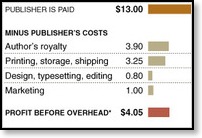
The Economics of Producing a Book
Publishers largely agree, which is why in negotiations with Apple, five of the six largest publishers of trade books have said they would price most digital editions of new fiction and nonfiction books from $12.99 to $14.99 on the forthcoming iPad tablet — significantly lower than the average $26 price for a hardcover book.
But publishers also say consumers exaggerate the savings and have developed unrealistic expectations about how low the prices of e-books can go. Yes, they say, printing costs may vanish, but a raft of expenses that apply to all books, like overhead, marketing and royalties, are still in effect.
All of which raises the question: Just how much does it actually cost to produce a printed book versus a digital one?
In the emerging world of e-books, many consumers assume it is only logical that publishers are saving vast amounts by not having to print or distribute paper books, leaving room to pass along those savings to their customers.
The Economics of Producing a Book
Publishers largely agree, which is why in negotiations with Apple, five of the six largest publishers of trade books have said they would price most digital editions of new fiction and nonfiction books from $12.99 to $14.99 on the forthcoming iPad tablet — significantly lower than the average $26 price for a hardcover book.
But publishers also say consumers exaggerate the savings and have developed unrealistic expectations about how low the prices of e-books can go. Yes, they say, printing costs may vanish, but a raft of expenses that apply to all books, like overhead, marketing and royalties, are still in effect.
All of which raises the question: Just how much does it actually cost to produce a printed book versus a digital one?
Daily routines
03/04/10 16:46 Filed in: miscellany
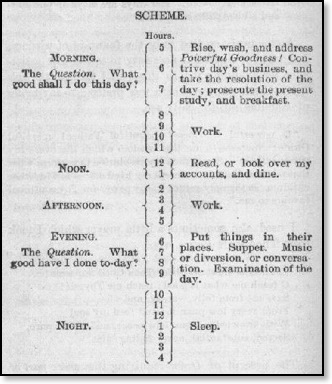
The Daily Routines
site
is a wonderful time waster. It has pulled together
writers, artists, and interesting people from all
walks of life and notes their daily routines for
working and playing. Here's an excerpt from Benjamin
Franklin:
Now you can dress like the Norwegian curling team!
03/02/10 16:44 Filed in: miscellany

I have decided I like curling - it seems like the ice version of lawn bowling, which is something I do whenever I visit Seattle. I have friends there who go every Sunday, have a potluck breakfast, and then we all put on large hats and summery white clothes, and have a great time messing up every ball we throw.
Curling seems like the perfect winter alternative, but I have nothing in my wardrobe to match what the Norwegians wore. Now you can buy the same pants! NPR has the links!
A new alternative energy source for the home?
03/01/10 16:42 Filed in: miscellany
I'm up for this, if it is cost effective and
nondestructive:
Bloom Energy is developing a power box for the home too, a development that could fundamentally change the way home users buy energy, if (again) the Bloom box is the real deal.
More here! I hope it is not pie in the sky...... sigh.
Bloom Energy is developing a power box for the home too, a development that could fundamentally change the way home users buy energy, if (again) the Bloom box is the real deal.
More here! I hope it is not pie in the sky...... sigh.