Google and indy booksellers team up
06/30/10 11:08 Filed in: publishing
| ebooks
Later this summer, Google plans to introduce its
long-awaited push into electronic books, called
Google Editions. The company has revealed
little about the venture thus far, describing it
generally as an effort
to sell digital books that will be readable
within a Web browser and
accessible from any Internet-connected computing
device.
Now one element of Google Editions is coming into sharper focus. Google is on the verge of completing a deal with the American Booksellers Association, the trade group for independent bookstores, to make Google Editions the primary source of e-books on the Web sites of hundreds of independent booksellers around the country, according to representatives of Google and the association.
The partnership could help beloved bookstores like Powell’s Books in Portland, Ore.; Kepler’s Books in Menlo Park, Calif.; and St. Mark’s Bookshop in New York. To court the growing audience of people who prefer reading on screens rather than paper, these small stores have until now been forced to compete against the likes of Amazon, Apple and Sony.
More at the NYT....
Now one element of Google Editions is coming into sharper focus. Google is on the verge of completing a deal with the American Booksellers Association, the trade group for independent bookstores, to make Google Editions the primary source of e-books on the Web sites of hundreds of independent booksellers around the country, according to representatives of Google and the association.
The partnership could help beloved bookstores like Powell’s Books in Portland, Ore.; Kepler’s Books in Menlo Park, Calif.; and St. Mark’s Bookshop in New York. To court the growing audience of people who prefer reading on screens rather than paper, these small stores have until now been forced to compete against the likes of Amazon, Apple and Sony.
More at the NYT....
Where people are moving
06/17/10 11:06 Filed in: miscellany

Cool interactive map of where people are moving to and from on a county and city basis. Check out your county at Forbes
Google's new search algorithm - Caffeine
06/15/10 11:05 Filed in: search
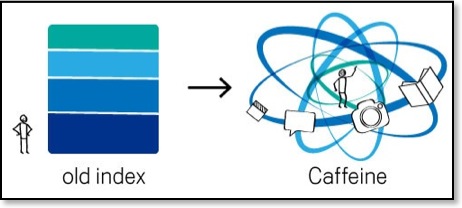
“Our old index had several layers, some of which were refreshed at a faster rate than others; the main layer would update every couple of weeks. To refresh a layer of the old index, we would analyze the entire web, which meant there was a significant delay between when we found a page and made it available to you.
With Caffeine, we analyze the web in small portions and update our search index on a continuous basis, globally. As we find new pages, or new information on existing pages, we can add these straight to the index. That means you can find fresher information than ever before—no matter when or where it was published.”
More here....
Nice library, and it includes the hand from the Addams Family
06/14/10 11:02 Filed in: books
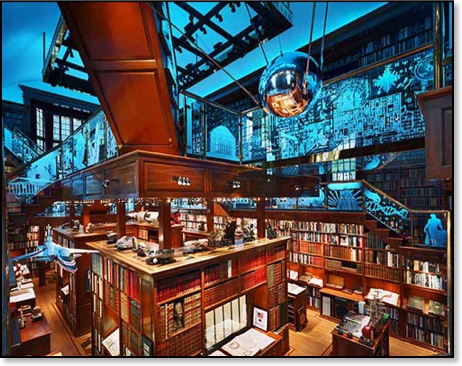
Internet entrepreneur Jay Walker used his fortune to create an elaborate library filled with intellectual achievements spanning human history.
This private library is 3,600 square feet filled with landmark and
bejeweled books, an early edition of Chaucer, a small earth globe signed
by nine astronauts, a 300-million-year old trilobite fossil, the
original hand prop from the TV show The Addams Family, a hand-painted
“celestial atlas” from 1660, an original copy of The Nuremberg Chronicle
from 1493, a working version of a Nazi-era Enigma machine, an original
Sputnik 1 satellite hanging from the ceiling, a chandelier from a James
Bond film, the napkin that Roosevelt sketched out his plan for victory
in 1943, a field tool kit for Civil War surgeons, all encompassed in
three levels packed with more rare artifacts than your local history
museum.
Books as databases
06/11/10 11:00 Filed in: books
So what would a relational database of a book
look like in diagram form? Somewhat similar. Like
this:
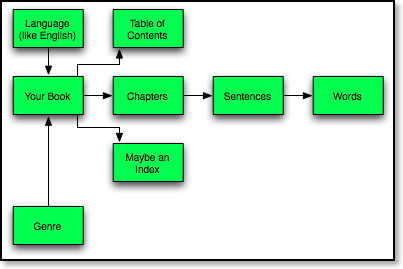
The book is the anchor of this relational database much like the recipe box is in the recipe box example. Inside the book: chapters, a table of contents, maybe an index. Each chapter is made up of sentences (at least sentences…maybe pictures, too!) and each sentence is made up of words.
What is this "maybe an index" bit?
Here's a bit more from Chris Kubica at Publishing Perspectives:
Writing/building a book-as-database from the start requires thinking about how the contents of a book can later be searched, shared, aggregated, re-organized, re-presented, re-purposed and indexed.
However, the interface for readers and even for the author need not be complex or extra-technical in the slightest. A writer could write the book the “old fashioned way”, using a word processor and then upload the manuscript to be “processed” into database format by the publishing platform (more on platforms later). Or a writer could simply write right in a Web browser while the platform automatically saves the work regularly into book-as-database format.
The book is the anchor of this relational database much like the recipe box is in the recipe box example. Inside the book: chapters, a table of contents, maybe an index. Each chapter is made up of sentences (at least sentences…maybe pictures, too!) and each sentence is made up of words.
What is this "maybe an index" bit?
Here's a bit more from Chris Kubica at Publishing Perspectives:
Writing/building a book-as-database from the start requires thinking about how the contents of a book can later be searched, shared, aggregated, re-organized, re-presented, re-purposed and indexed.
However, the interface for readers and even for the author need not be complex or extra-technical in the slightest. A writer could write the book the “old fashioned way”, using a word processor and then upload the manuscript to be “processed” into database format by the publishing platform (more on platforms later). Or a writer could simply write right in a Web browser while the platform automatically saves the work regularly into book-as-database format.
Digitizing the past at the Library of Congress
06/10/10 10:59 Filed in: books
"It's incredible, it's humbling. It might be 6
p.m. and I'll be exhausted but I think, 'I can't
complain--I'm working with the Gettysburg Address!'"
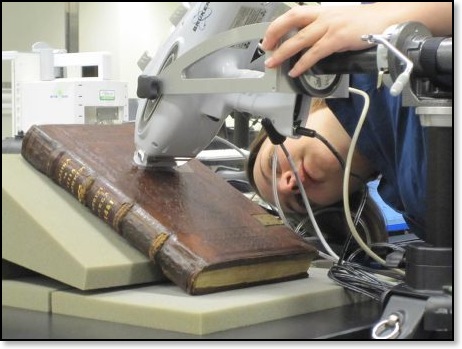
The Library of Congress has nearly 150 million items in its collection, including at least 21 million books, 5 million maps, 12.5 million photos and 100,000 posters. The largest library in the world, it pioneers both preservation of the oldest artifacts and digitization of the most recent--so that all of it remains available to future generations.
Amazing collection of photos of their work here. Great rewinding equipment for various kinds of tape, x-ray machines, and other methods of collecting data from fragile items.
The Library of Congress has nearly 150 million items in its collection, including at least 21 million books, 5 million maps, 12.5 million photos and 100,000 posters. The largest library in the world, it pioneers both preservation of the oldest artifacts and digitization of the most recent--so that all of it remains available to future generations.
Amazing collection of photos of their work here. Great rewinding equipment for various kinds of tape, x-ray machines, and other methods of collecting data from fragile items.
Most misspelled words on Google
06/07/10 10:56 Filed in: silliness
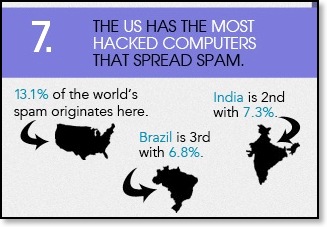
The examples of misspellings that Google sees
most often are typos of very frequently searched
terms, such as “Criagslist” instead of “Craigslist”
and “Facebok” instead of “Facebook.” But Mr. Paskin
said
words that aren’t spelled the way they sound also
give people trouble.
He cited a few of the most common examples:
* “definitely,” which is often spelled “definately,” “definetly” or “definatly” * “stilettos,” which people spell “stilletos,” and “stillettos” * “mischievous,” spelled “mischevious” and “mischievious” and * “nauseous,” which comes out “nautious,” “nauseas” and “nausious.”
Stilettos? Really, is that a most used term?
More here at the WSJ
He cited a few of the most common examples:
* “definitely,” which is often spelled “definately,” “definetly” or “definatly” * “stilettos,” which people spell “stilletos,” and “stillettos” * “mischievous,” spelled “mischevious” and “mischievious” and * “nauseous,” which comes out “nautious,” “nauseas” and “nausious.”
Stilettos? Really, is that a most used term?
More here at the WSJ
The iPad doesn't like hot summers in the city
06/06/10 10:55 Filed in: ebooks
Baratunde
Thurston,
a Web editor for
The Onion,
set out to enjoy a relaxing afternoon at
the
High Line
park in New York City when his iPad decided to
take a nap instead. Mr. Thurston said it only took
five minutes before the device shut down, and another
20 minutes in the shade before it started up again.
To fix the problem Mr. Thurston said he took the iPad out of the Apple-brand rubber protective case he had purchased to protect it from drops and scratches. He theorized that the sleeve could cause the iPad to heat up quicker than normal, acting like a fur coat on a hot summer day.
Apparently some naked iPads overheat too.
Michael Galpert, who is a co-founder of Aviary.com, which makes free online design software, said he took his iPad to the beach while it was “bare” and “naked.” After he used it for a few minutes it shut down and showed the temperature warning. Mr. Galpert explained that he then used a Kindle instead, which worked continuously for the next two hours without any heat issues.
More at the NYT. Well, being a desert dweller, that's not a feature, that's a bug! I have to admit that bare naked iPads are an amusing thought.
To fix the problem Mr. Thurston said he took the iPad out of the Apple-brand rubber protective case he had purchased to protect it from drops and scratches. He theorized that the sleeve could cause the iPad to heat up quicker than normal, acting like a fur coat on a hot summer day.
Apparently some naked iPads overheat too.
Michael Galpert, who is a co-founder of Aviary.com, which makes free online design software, said he took his iPad to the beach while it was “bare” and “naked.” After he used it for a few minutes it shut down and showed the temperature warning. Mr. Galpert explained that he then used a Kindle instead, which worked continuously for the next two hours without any heat issues.
More at the NYT. Well, being a desert dweller, that's not a feature, that's a bug! I have to admit that bare naked iPads are an amusing thought.
The web shatters your focus
06/04/10 10:54 Filed in: reading
Navigating linked documents, it turned out,
entails a lot of mental calisthenics—evaluating
hyperlinks, deciding whether to click, adjusting to
different formats—that are extraneous to the process
of reading. Because it disrupts concentration, such
activity weakens comprehension. A 1989 study showed
that readers tended just to click around aimlessly
when reading something that included hypertext links
to other selected pieces of information. A 1990
experiment revealed that some “could not remember
what they had and had not read.”
Even though the World Wide Web has made hypertext ubiquitous and presumably less startling and unfamiliar, the cognitive problems remain. Research continues to show that people who read linear text comprehend more, remember more, and learn more than those who read text peppered with links. In a 2001 study, two scholars in Canada asked 70 people to read “The Demon Lover,” a short story by Elizabeth Bowen. One group read it in a traditional linear-text format; they’d read a passage and click the word next to move ahead. A second group read a version in which they had to click on highlighted words in the text to move ahead. It took the hypertext readers longer to read the document, and they were seven times more likely to say they found it confusing. Another researcher, Erping Zhu, had people read a passage of digital prose but varied the number of links appearing in it. She then gave the readers a multiple-choice quiz and had them write a summary of what they had read. She found that comprehension declined as the number of links increased—whether or not people clicked on them. After all, whenever a link appears, your brain has to at least make the choice not to click, which is itself distracting.
There's lots more, and it is astonishing, at Wired....
Even though the World Wide Web has made hypertext ubiquitous and presumably less startling and unfamiliar, the cognitive problems remain. Research continues to show that people who read linear text comprehend more, remember more, and learn more than those who read text peppered with links. In a 2001 study, two scholars in Canada asked 70 people to read “The Demon Lover,” a short story by Elizabeth Bowen. One group read it in a traditional linear-text format; they’d read a passage and click the word next to move ahead. A second group read a version in which they had to click on highlighted words in the text to move ahead. It took the hypertext readers longer to read the document, and they were seven times more likely to say they found it confusing. Another researcher, Erping Zhu, had people read a passage of digital prose but varied the number of links appearing in it. She then gave the readers a multiple-choice quiz and had them write a summary of what they had read. She found that comprehension declined as the number of links increased—whether or not people clicked on them. After all, whenever a link appears, your brain has to at least make the choice not to click, which is itself distracting.
There's lots more, and it is astonishing, at Wired....
Publish yourself on the iPad
06/03/10 10:52 Filed in: ebooks | publishing
Apple has provided a publishing service on the
iPad for those who don't want to go through all the
hassle of finding a publisher.
Responding to a long-standing enquiry from Mac Life, Cupertino is now inviting budding authors to sign up for self-publishing, as long as the work is in ePub format, the author has an ISBN and a US Tax ID, and is using an Apple Mac, obviously.
Self-publishing, also known as "vanity publishing", has been around slightly longer than professional publishing, but electronic distribution puts the means of production into the hands of the author.
This means you can publish a book for a few quid, though publication is no guarantee of sales. You could, of course, put your Great American Novel onto the internet, but unless you're writing for love* you'll need some sort of revenue stream, which iBookStore can provide.
You'll need an ISBN - a unique number identifying every book published. Those come in batches of 10 and will set you back £111 if you're British, but only $30** if you're American which is more likely if you've the mandatory US Tax ID too.
More at The Register
Responding to a long-standing enquiry from Mac Life, Cupertino is now inviting budding authors to sign up for self-publishing, as long as the work is in ePub format, the author has an ISBN and a US Tax ID, and is using an Apple Mac, obviously.
Self-publishing, also known as "vanity publishing", has been around slightly longer than professional publishing, but electronic distribution puts the means of production into the hands of the author.
This means you can publish a book for a few quid, though publication is no guarantee of sales. You could, of course, put your Great American Novel onto the internet, but unless you're writing for love* you'll need some sort of revenue stream, which iBookStore can provide.
You'll need an ISBN - a unique number identifying every book published. Those come in batches of 10 and will set you back £111 if you're British, but only $30** if you're American which is more likely if you've the mandatory US Tax ID too.
More at The Register
Librarians do Lady Gaga
06/02/10 10:51 Filed in: silliness
See the whole thing here
It's the UW Library School, with many featured cameos - Nancy Pearl, Bob Boiko, etc.